All-on-4: is it right for you?
All-on-4 replaces a whole arch of failing or missing teeth with a fixed bridge carried on four implants. It suits people who wear dentures, or who are close to losing most of the teeth in an arch. If you are missing one or two teeth, an individual implant or a bridge is the better comparison.
The question in the title has a real answer. All-on-4 suits one particular situation very well, and it is the wrong treatment for several others. Here is how to tell which of those you are in.
What it actually is
An arch is a full row of teeth, upper or lower. All-on-4 replaces one of them with a single fixed bridge, carried on four implants rather than one implant per tooth.
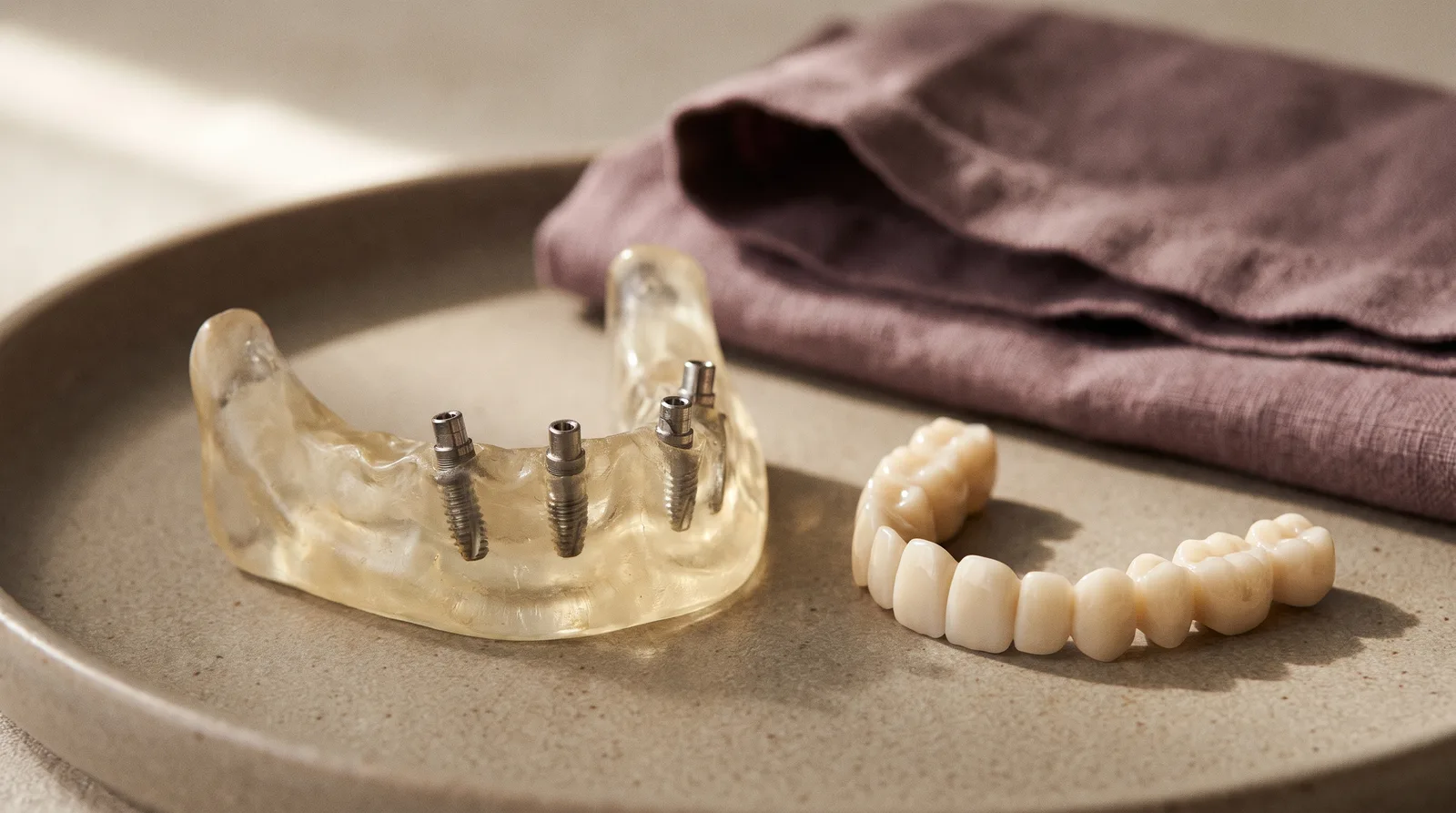
The four go in where the bone is strongest, which is worked out beforehand from 3D imaging and surgical planning software, not decided on the day. That planning is also why the treatment can usually avoid the bone grafting individual implants often need.
Who it suits
Broadly, two groups of people.
The first is denture wearers. If you already have a full denture and the daily reality of it has worn thin, a fixed arch is a different proposition. It does not come out, and you do not manage it; you brush it.
The second is people close to losing most or all of the teeth in an arch, where saving them one at a time has stopped being realistic and the honest conversation is about what replaces them.
Who it does not suit
If you are missing one tooth, or two, this is not your comparison. An individual implant or a bridge does that job, and doing it well costs considerably less: £4,000 for a single implant and its crown against £20,625 for a whole arch, or £3,200 and £16,500 respectively on our membership plan.
Suitability for All-on-4 is confirmed at consultation, not before it. Anyone who tells you otherwise has not looked at your jaw.
What the timeline looks like
- Assessment. We look at your jawbone with 3D imaging and plan where the four implants go.
- Placement. For suitable patients, all four go in during a single appointment, which can sometimes mean walking out with a whole new smile within a few hours.
- Healing. Three to six months, while the bone integrates with the implants.
- The final bridge. Made bespoke in a dental laboratory and fitted onto your implants. Fitting it needs no further anaesthetic, so this stage involves no more needles.
Two different pieces of cover, worth telling apart
Our own three-year guarantee covers the work, with an option to extend it when those three years end. Terms are available in practice.
Separately, the implants themselves carry Nobel Biocare’s manufacturer warranty, which replaces the implant for as long as you have it. That warranty covers the product, not the cost of treatment. Full terms are available on request.
People often hear “guarantee” and “warranty” as one thing. They are not, and the difference is worth understanding before you sign anything.
Where we do it
All-on-4 is available across the group. Our Ashby-de-la-Zouch and Higham Ferrers practices are additionally recognised as a Nobel Biocare All-on-4 Centre of Excellence, a distinction held by only a handful of practices nationwide.
A full arch is a large decision and there is no good reason to make it quickly. Come in, look at the imaging, and ask what happens if it turns out not to suit you. That conversation settles most of it.